Where Home Drywall Patching Stops
What a homeowner can reasonably patch, what it takes, and where the line falls.
A fair share of drywall damage can be handled by a patient homeowner with modest tools. Difficulty begins when a repair looks minor but rests on a larger cause, or when the finish proves harder to copy than expected. This guide separates the two.
Start with the jobs you can handle
Screws that have backed out
A circular swelling, or a ring of split paint over a fastener, tells you the screw or nail has worked loose. Drive a new drywall screw roughly 1½ inches above or below it so the board is drawn snug to the stud, then set the old fastener just under the surface. Two skim passes of lightweight compound over both, a gentle sanding and a dab of primer complete it.
Dings and pinholes
Furniture dings and the holes left by picture hooks or anchors need only lightweight spackle or compound, put on in a pair of thin layers instead of one heavy one, sanded level and primed.
Palm-sized openings
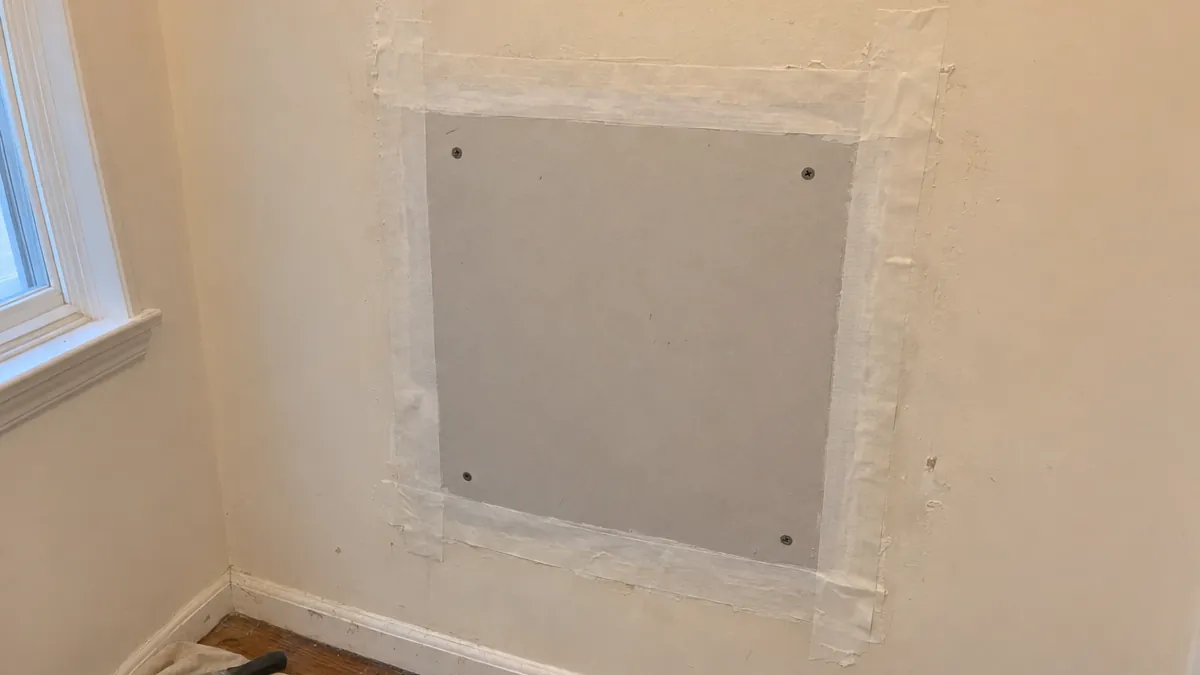
Hardware stores sell self-adhesive mesh repair squares, and one of those bridges an opening up to about the width of your palm. Press it on, cover it with three coats of compound, every coat a couple of inches broader than its predecessor, and sand between them. The usual error is a coat kept too narrow, which leaves a visible hump; the last coat should extend well past the mesh on every side.
Hairline cracks that hold still
A fine crack that has not changed in a month can be widened a touch with a utility knife, covered with mesh tape, and finished with two or three feathered coats. Packing it with spackle alone tends to let it come back.
Gather the right tools
- Two taping knives, one narrow (about six inches) and one broad (about a foot), with a mud pan
- Lightweight joint compound, plus a small bag of setting compound for quicker coats
- Mesh tape, paper tape and a few peel-and-stick repair squares
- A sanding sponge or pole sander, a utility knife and a jab saw
- Drywall screws and a drill fitted with a dimpler bit
- Stain-sealing primer and the wall color, along with a dust mask and drop cloths
Watch for signs it needs a pro
The points below mark where a patch turns into a repair better arranged through a drywall contractor.
- Water played a part. Gypsum that was soaked, feels spongy or smells musty needs meter readings and probably removal, not a patch. EPA guidance is to dry water-damaged materials within 24 to 48 hours to prevent mold.
- The damage is overhead. Ceiling work is harder to get flat and harder to do safely, and a ceiling holding water is a real hazard: shut off power to the light fixtures nearest the soaked area first of all, and stay out from under it.
- The opening exceeds the span of your hand. Damage that size needs backing, an inserted piece of board and taped joints to stay flat.
- The crack came back. A crack that reappears after patching sits on a moving joint, and occasionally hints at movement worth an engineer's opinion.
- The texture is awkward. Knockdown and orange peel are hard to imitate by hand, and a smooth patch on a textured wall stands out plainly.
- The height is beyond a stepladder. Stairwells, great rooms and vaulted ceilings require staging.
Take care in an older Accokeek house
Five-year Census estimates through 2024 place 1,119 Accokeek homes before 1970. If yours is among them, two points deserve attention. Firstly, certain older walls are plaster rather than drywall, and plaster is mended differently. Secondly, the EPA observes that houses put up before 1978 more often carry lead-based paint, so sanding old paint without precautions can spread contaminated dust. If you are unsure about your paint, test it before sanding, or leave that wall to a pro who follows lead-safe practices.
Accokeek's muggy summers also lengthen curing. A coat of compound that would be ready in a few hours in January may want a full night in August, and sanding a coat that has not cured tears the surface.
Hand off the bigger jobs
When a hole, crack or stain falls beyond that line, see how larger holes are patched and finished, or read about repairing basement walls after water. You are welcome to phone or send a picture for a quote in either case. Further reading will appear on the drywall guides page.
Arrange your repair quote
Tell us about the damage by phone, send a picture, or complete the form. The price comes first, and work is scheduled only when you are ready.
Whoever prices your job will phone to go over it with you and settle on a date that suits.